Have you stopped to think about what it really takes to run a single production line processing 700,000 barrels of crude a day? Well, I hadn’t either; at least not until I started digging into how Dangote Refinery actually holds together.
The number of barrels is hardly the interesting part. What stopped me was realizing there’s no second line to fall back on. Think about it for a second; this is one process, running at that scale, with nothing standing between a small mistake and a full shutdown. I’ve researched a lot of operations over the years, and the ones that survive at this scale all have the same thing running behind and maybe underneath them: a quality management system built to catch a problem before it becomes a disaster.
In this article, I’ll walk through how Dangote Refinery reached this scale in the first place, what a quality management system actually does, and why the same principles apply as someone running a refinery or a five-person business. Let’s start with a short story of how the refinery got here in the first place.
Key Takeaways
- A quality management system, or QMS, is the written set of processes a business follows to get the same result every time, no matter who is doing the work.
- The bigger an operation gets, the more a single mistake costs, which is why catching it early matters more as a business grows.
- A QMS has five core pieces: documented processes, quality objectives, monitoring and measurement, corrective action, and continuous improvement.
- ISO 9001 is the standard most people mean when they talk about a QMS, and it is the one a business can be certified to. ISO 9000 only explains the vocabulary and principles behind it.
- A business of any size can start with the one process that would hurt most if it went wrong, and write down exactly how it should happen.
- In Nigeria, getting certified usually takes three to nine months and costs roughly ₦1.25 million to ₦6.5 million, through a certification body accredited by NiNAS or an internationally recognized one.
How Did Dangote Refinery Get Here? Quality Management System
Aliko Dangote announced this refinery in 2013, promising something big enough to end Nigeria’s decades-long dependence on imported fuel. The original plan called for about $9 billion in financing and 2016 as the completion date. I keep coming back to that number, because it is hardly close to what this project really ended up costing.
In reality, that’s not what happened. The site moved to a 6,180-acre plot in the Lekki Free Trade Zone just outside Lagos. The relocation pushed everything back. Plus, the full construction didn’t even start until 2016 and 2017, years past the original target. Two major international firms came on to get it built: China National Chemical Engineering Company handled the engineering and construction under a $520 million contract, and Engineers India Limited managed the project under a separate $139 million deal. Even with that kind of firepower behind it, the timeline kept slipping.
Every delay and every design change pushed the cost higher. By 2018, the full project, fertilizer plant and pipeline network included, was already running around $15 billion. The refinery alone eventually cost more than $19 billion, and at that point, it still hadn’t produced a single drop of fuel.
And then the ramp-up happened fast. The first crude delivery came in December 2023; a million barrels of Agbami crude shipped in. It started processing that crude in January 2024 and began producing diesel and aviation fuel the same month. Petrol didn’t start until September 2024. This was the first time petrol had come out of a Nigerian refinery in 28 years. Full refining capacity followed in February 2026. That’s a lot of firsts packed into a little over two years.
As of June 2026, an industry report stated that the refinery was processing around 700,000 barrels of crude a day, above its original 650,000 barrel nameplate design, with an expansion already announced that would push it to 1.4 million barrels a day within thirty months. Dangote refinery is now the world’s largest single train refinery, meaning the entire operation runs through one continuous crude distillation unit instead of several smaller parallel units that could absorb a failure elsewhere. In plain terms, that means if one part of the process breaks, there’s nothing else running to keep production going.
Furthermore, it’s also become the world’s largest exporter of jet fuel, and several African governments are now seeking long-term fuel supply agreements with it. That’s a real shift after decades of Nigeria importing nearly all of its refined fuel.
Running a single train at that scale carries a particular kind of exposure. There’s no second production line waiting in the wings if one process step drifts out of control, and every barrel that leaves the site has passed through the same continuous process.
I haven’t seen Dangote Refinery’s certification records, and I’m not claiming to know which specific standards it holds. What I can say plainly is this: an operation built over more than a decade of delays, relocations, and cost overruns before it ever produced a drop of fuel is a case study in what ISO 9001 is built to do. I mean turning a single point of failure into a documented, audited system that catches a defect while it’s still small enough to fix.
So what exactly is a quality management system?
What Is a Quality Management System?
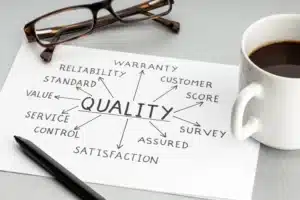
A quality management system, or QMS, is the documented set of processes a company uses to make sure its product or service turns out the same way every time, no matter who’s doing the work or what shift they’re on.
That’s the general definition. In practice, what it really means is that instead of relying on one skilled operator to catch problems by instinct, a QMS writes the process down, sets a standard for what “correct” looks like, and builds in checkpoints that catch an issue or problem before it moves any further down the line.
When I talk about this, a very popular example that comes to mind is Chicken Republic. Have you noticed that when you’re eating there in Lekki or in Kano, the jollof rice tastes the same, the chicken is fried the same way, and the portion sizes don’t change? Do you really think this is a coincidence or by accident? It’s definitely not.
One chef is definitely not getting lucky across 200 locations. Rather, it is a documented process, followed the same way at every outlet, with checks built in to catch it when a location drifts from the standard.
The same thing applies with most banks across the globe. Walk into any GTBank branch in the country, for instance; the account opening process is usually the same, down to the documents they ask for and the order they ask for them. A hospital sterilizing equipment before surgery is running a QMS too, just one where the stakes of skipping a step in the process are excessively higher than jollof rice tasting slightly off in Chicken Republic.
I think people overcomplicate this by thinking a QMS is a binder full of policies nobody reads. At its core, it’s four very important things: a defined process for how work gets done, a way to measure if that process is actually being followed, a system for catching and documenting when something goes wrong, and a loop that feeds those findings back into fixing the process itself.
Most industries build their QMS around a recognized framework, ISO 9001 being the most widely used, but the framework is hardly the point. The point is the discipline behind it, knowing exactly what’s supposed to happen at every step, and having a way to prove it happened.
So if that’s the case, then it’s almost certain that Dangote Refinery wouldn’t have been able to pull this off without a quality management system like ISO 9001 in place.
3 Lessons to Learn From the Dangote Refinery Story
Most businesses get to make mistakes and get a second chance at trying to fix those mistakes. A restaurant could have a bad night and try again tomorrow. A shop could get away with mislabelling a shipment by fixing it before the next one goes out. There’s almost always a next try, a second batch, and a chance to catch the error before it costs too much.
Dangote Refinery doesn’t get that opportunity. One production line and every barrel running through it means there is no second line waiting to pick up the slack while the first one gets fixed. When one step goes wrong, it affects all of the output, because everything passes through the same line.
1. A Small Mistake Gets Bigger as the Operation Gets Bigger
So what does that actually look like? Say a contamination problem goes unnoticed for hours instead of minutes. By then, a full day’s output has already moved through the pipelines and onto ships. Or a pressure reading drifts too far and nobody flags it in time, which can stop production until someone finds the cause.
2. Fix Problems Before They Cause Damage
I’ve looked at enough operations to know most companies catch problems the hard way: a customer complains, a batch fails inspection, or something breaks down on the floor. By then the damage is already done, and the fix only stops it from happening again. A refinery can’t afford to work that way, because by the time a complaint arrives, millions of dollars of product are already out the door.
3. Add Things One Step at a Time
The way the refinery came online gave me a third lesson. Diesel and jet fuel came first, and petrol followed months later. I can’t say why it was sequenced that way, but a business that adds one new product or service at a time gets to confirm that each one works before the next one arrives. A problem found on the first is far cheaper to fix than the same problem found on three at once.
All three lessons depend on checks that run all day, and the next section shows what those checks are made of.
What Are the Core Elements of a Quality Management System?
Essentially, a quality management system has five core pieces, and at an operation the size of Dangote Refinery, each one has to hold up under a lot of pressure.
1. Documented Processes
Every step in the refining process gets written down. This generally includes what temperature a unit should run at, how long a batch sits before moving to the next stage, and who signs off before crude moves from one process to the next.
At a smaller operation, a supervisor might carry a lot of that knowledge in their head. At this scale, nothing can live only in someone’s head. If a process is not written down, there’s no way to check whether it’s actually being followed and no way to train the next person the same way.
2. Quality Objectives
A QMS sets specific, measurable targets. Think specific numbers: sulfur content within a certain range, moisture levels below a set threshold, and a target for how many batches pass inspection on the first try. At a refinery producing 700,000 barrels a day, these targets usually get broken down by unit and by shift, so a problem gets traced back to exactly where it started instead of getting lost in a plant-wide average.
3. Monitoring and Measurement
This is the part that actually catches problems. Sensors track pressure, temperature, and flow rate in real time, and samples get pulled and tested at set intervals. Every reading gets compared against the standard, and when something drifts outside the range, it gets flagged immediately instead of waiting for someone to notice later. At this scale, monitoring happens around the clock.
4. Corrective Action
When something does go wrong, the first move is to contain it immediately. After that, the real work starts: figuring out why it happened in the first place, usually through some version of root-cause analysis, and checking whether the same issue is showing up anywhere else on the line. The process itself gets changed based on what’s found. Skip that step, and the same problem just comes back in a different form.
5. Continuous Improvement
Every audit finding, every customer complaint, every data point from monitoring feeds back into reviewing the process and making it better. The system keeps changing as the operation does. At a refinery already running above its original design capacity and expanding toward 1.4 million barrels a day, that loop matters more than almost anywhere else, because the system has to keep up with an operation that keeps growing.
ISO 9001 and Other QMS Frameworks
When people say “quality management system,” they’re usually thinking of ISO 9001 without even knowing the name. It’s the most widely used quality standard in the world, built around six requirements: leadership actually committing to quality, a process-based way of running operations, thinking in terms of risk before it becomes a problem, keeping documented records, measuring performance, and continuously improving based on what that measurement shows. That list should look familiar, because it’s close to what we already walked through in the last section.
Certification isn’t automatic and it isn’t self-declared. An independent certification body audits the company against the standard, and ISO itself doesn’t hand out the certificates. Companies usually go through this for supplier approval, to win government contracts, or because a partner simply won’t work with them otherwise.
For an operation in oil and gas specifically, ISO 9001 often is hardly the only standard in play. The American Petroleum Institute has its own certification, API Q1, built on top of ISO 9001 with more than 85 additional requirements aimed specifically at risk and defect prevention: formal risk assessment at every stage of production, backup supplier plans, a documented quality plan for each order, stricter testing before a design gets approved, and suppliers held accountable through mandatory annual audits. Major operators like ExxonMobil, Saudi Aramco, and Shell require it, not as a nice-to-have but as a condition of doing business with them.
This is where I have to be upfront about something: none of this tells us which certification Dangote Refinery actually holds. That’s not information that’s publicly available in a way I can verify, so I’m not going to guess at it. What’s true regardless is that a single production line moving 700,000 barrels a day is exactly the kind of operation these standards exist for. Call it ISO 9001, API Q1, or something else entirely, the certificate’s name matters less than whether the system behind it actually catches a problem before it turns into 700,000 barrels of the same mistake.
One more thing worth clearing up: ISO 9000 and ISO 9001 aren’t the same thing, even though people use the names interchangeably. ISO 9000 is more like a reference guide, it lays out the basic vocabulary and principles behind quality management, things like customer focus and continual improvement. You can’t actually get certified to it. ISO 9001 is the one with real requirements a company has to meet, and it’s the one that leads to an actual certificate. So if someone tells you their business is “ISO 9000 certified,” what they likely mean is ISO 9001.
What This Means for Smaller Businesses
Most of the businesses reading this aren’t running a refinery, and that’s exactly the point. You don’t need an operation anywhere near that size for a repeated mistake to actually cost you something. You just need to be the kind of business that can’t afford to make the same error twice.
To put things in perspective, here’s the honest question most small business owners should ask: if your best employee left tomorrow, would things still run the same way?
For a lot of businesses, the answer is no, and that’s the real gap a quality management system is meant to close. You don’t need 700,000 barrels a day of exposure for that gap to cost you a customer.
The starting point isn’t really that complicated. You can start by picking one process that matters most to your business right now, the one that would hurt the most if it went wrong, and writing down exactly how it’s supposed to happen, not everything at once. One process, done properly, teaches you more about building a system than five written half-heartedly.
From there, pay attention to what actually goes wrong. Most small businesses already know their recurring problems. The problem is that they either just haven’t connected the dots or just ignore it entirely because of the fear of what they might find. If customers keep complaining about the same thing, that’s usually a process that’s never been fixed at the root.
This is the part Astute Business Consult spends most of its time on: helping businesses build the habit of catching problems early and fixing them for good. A refinery had to learn this out of necessity, and a small business gets to learn it before the stakes get that high.
How to Implement a Quality Management System in Nigeria
If you’re running a business in Nigeria and actually want to put one of these systems in place, the journey looks roughly the same whether you’re a five-person company or a much larger one, just with the scale adjusted.
Start With a Gap Analysis
Before you change anything, you need an honest look at where your business actually stands. A gap analysis compares how things run today against what a standard like ISO 9001 requires, and it tells you exactly what’s missing before you spend time or money fixing the wrong thing. If you skip this step chances are, you end up building a system around problems you don’t actually have.
Get Leadership to Commit, Not Just Approve
This is where a lot of implementations quietly fail. Someone at the top has to actually commit. This means setting aside a real budget, appointing one person to own the project, and writing an actual quality policy as oposed to a vague mission statement pinned on the wall.
Without that commitment, the project stalls the moment it stops being convenient.
Build the System and Put It to Work
This is where the gap analysis turns into something real: the processes, procedures, and records that make up the system itself, written the way the business actually operates. Every employee who touches the work needs to understand what’s changing and why. Then the system has to run in live operations for a few months, so there’s real evidence it functions before anyone outside the business looks at it.
Audit It Yourself Before Anyone Else Does
An internal audit checks whether the system is actually being followed day to day. Leadership then reviews the results, looking at performance, audit findings, and customer feedback, and decides what still needs fixing before moving to certification.
Get Certified
If you want the formal ISO 9001 certificate, the final step is an external audit through a certification body accredited by Nigeria’s accreditation body, NiNAS, or by an internationally recognized one. This usually happens in two stages: the first checks whether your documentation and readiness look right, the second is a full on-site audit with interviews and process checks. If you clear both, and you get a certificate valid for three years, with annual check-ins to keep it active.
What to Expect in Time and Cost
Most Nigerian businesses go through this whole process in three to nine months. Costs vary by provider, but expect to pay somewhere between ₦1.25 million and ₦6.5 million all in, covering consulting support, employee training, and the certification audit itself.
That’s a lot to manage on your own, especially while running the rest of your business. This is exactly where Astute Business Consult comes in, we help businesses work through each of these stages without losing months figuring it out from scratch.
Conclusion
Dangote Refinery didn’t get to 700,000 barrels a day by accident, and it didn’t get there without a system holding every part of that single production line together. The bigger an operation gets, the less room there is to absorb a mistake, and that’s really the whole point of this piece.
Most businesses will never run anything close to a refinery. But the same question applies at any size: if something went wrong tomorrow, would you catch it before a customer did? For a lot of businesses, honestly, the answer is still no.
If you’re ready to find out where your own business stands, we put together a short Quality Management System Readiness Checklist you can run through in a few minutes. It’s a good first step before you talk to anyone, including us.
Download Quality Management System Readiness Checklist
Astute Business Consult helps businesses in Nigeria build the systems that keep them running the way they’re supposed to, long before a problem forces the issue. If that’s where you are right now, we’d like to hear from you.